


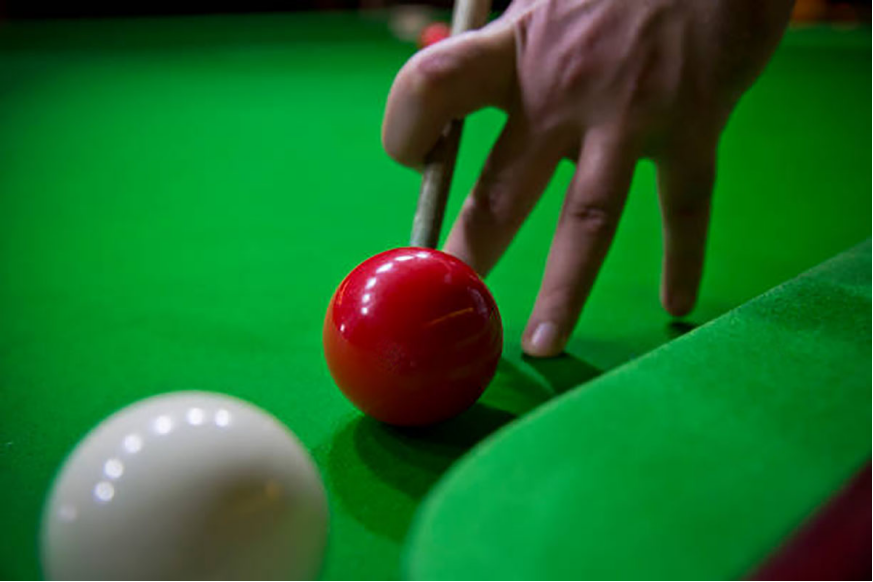
Often, when beginners finally start to build confidence, they encounter situations like this: the cue ball is blocked, and there’s no obvious path to the object ball. Someone might say, “Why don’t you just jump?”
This is when all sorts of questions arise. Is jumping a shot really allowed? Is it a trick shot or a foul? Why do some players succeed with jump shots while others fail?
If you’re a billiards beginner, it’s not surprising to feel confused. The jump shot rules straddle the line between skill and controversy. Let’s answer these questions in a simple, calm way, setting aside the complexities of the rulebook.
What Is a Jump Shot in Pool?
A jump shot, as the name suggests, involves striking the cue ball to briefly lift it off the table surface, thus clearing an obstacle ball. Jump shots may look fancy, but essentially, they’re just another problem-solving technique.
If executed correctly, the cue ball will cleanly clear the obstacle ball, land back on the pool table, and continue its journey towards the object ball. If executed incorrectly, a jump shot can scratch the table, go off the table, or even earn a disapproving shake of the referee’s hand.
Do You Need a Special Cue to Jump Shots?
Strictly speaking, no, but using a special cue can be helpful. Many players use a dedicated jump cue, which is shorter and stiffer, making it easier to pop the cue ball cleanly. Others manage jump shots with a standard cue sticks pool cue, especially once their technique improves.
If you are still learning, it is recommended to focus on the basics first. Once your skills have improved, you can then learn how to choose the appropriate cue.
Is the Jump Shot Legal?
In short: Yes, in most billiards rules, jump shots are legal, provided they are executed correctly. Beginners often make mistakes here. Legality depends on how the cue ball bounces. In plain terms: if it looks like a shovel rather than a strike, it’s a foul.
Legal jump shots:
- The cue tip strikes downward on the cue ball
- The cue ball jumps due to natural rebound, not scooping
- The shot is controlled and within table rules
Illegal jump shots (fouls):
- Scooping the cue ball upward with the cue tip
- Lifting the cue under the ball
- Miscuing in a way that pushes the ball forward
Different Rules, Different Leagues
Another reason beginners get confused is that rules can vary slightly depending on where you play.
- World Pool-Billiard Association (WPA) rules: Jump shots are legal if executed properly
- Most UK leagues and clubs: Jump shots allowed, but with strict technique standards
- Some pubs or house rules: Jump shots banned entirely (often to protect the table)
Before attempting a jump shot, always check the local rules, especially in informal settings.
Cue Damage and Safety Issues?
Jump shots put stress on the cue and the table. This is why experienced players never use snooker cues designed for touch and technique for jump shots. A snooker cue is designed for precise shots, not vertical power; using them for jump shots will quickly damage the cue tip or shaft.
High-quality snooker cues are best used where they excel: smooth strokes, fine spin, and precise control of the cue ball.
Jump Shots vs Clever Positioning
Many professional players will tell you the unspoken truth: the best jump shots are often the ones you don’t need to use.
Jump shots look cool, but they’re risky. Beginners should generally:
- Learning safety play
- Using cushions creatively
- Improving cue-ball control
Jumping should be a solution of last resort, not a habit.
Is the Jump Shot Worth Learning?
Yes, but at the Right Time. For beginners, understanding the rules of jump shots is more important than mastering the technique itself. Knowing which moves are legal can help avoid embarrassment and fouls.
As confidence and ball control improve, adding jump shots to your repertoire becomes especially important, particularly in competitive play.
Know the Rules, Break Them Properly
Jump shots are not a trick. They are a legal, skillful shot, provided the movement is correct. For beginners, the key points are:
- Jump shots are legal
- Scooping is illegal
- Always check local rules
Learn the foundations first, respect the table, and use the jump shot when it truly makes sense. Because in pool, as in life, knowing when not to jump is often just as important as knowing how.
