


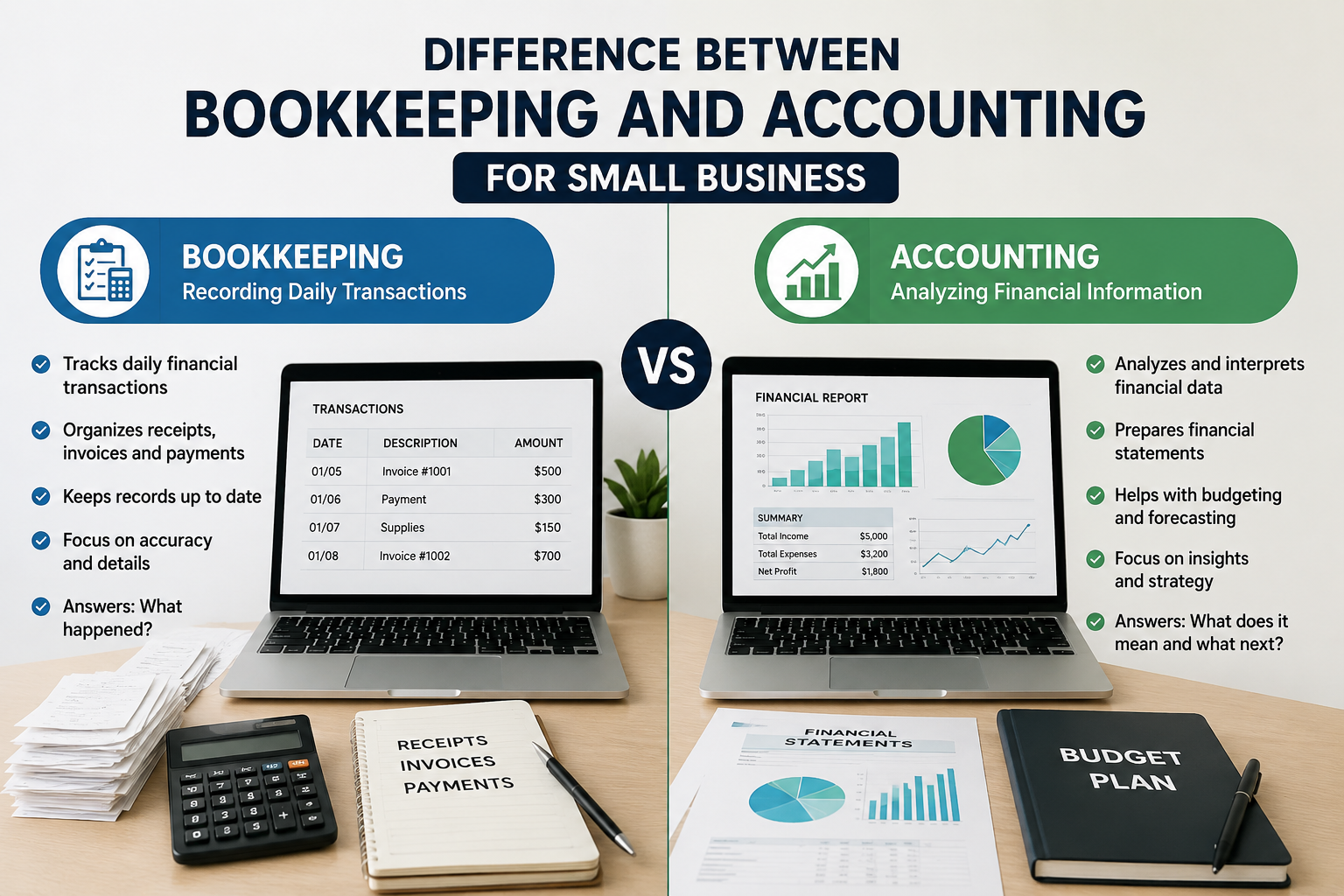
Running a successful small business requires precise financial management. Every sale, purchase, tax obligation, and strategic decision relies on clear financial records. However, business owners often confuse two fundamental financial roles: bookkeeping and accounting.
While both functions deal with company finances, they serve distinct purposes, require different skill sets, and impact business growth in separate ways. Understanding the contrast between bookkeeping and accounting ensures proper financial handling, compliance with regulations, and sound business decisions.
Core Definitions
What is Bookkeeping?
Bookkeeping is the systematic recording, organizing, and maintaining of daily financial transactions. It forms the foundational layer of financial management, documenting every monetary event occurring within the organization.
The primary objective of bookkeeping is administrative accuracy: ensuring every receipt, invoice, and bill is correctly categorized and logged.
Primary Responsibilities:
- Recording daily financial transactions (sales, payments, expenses)
- Managing accounts payable (paying vendors and bills)
- Managing accounts receivable (invoicing customers and tracking collections)
- Reconciling bank and credit card statements
- Processing payroll and related employee withholding documentation
- Storing and organizing supporting documents (receipts, receipts logs, vouchers)
What is Accounting?
Accounting takes the organized transactional data produced by bookkeeping and subjects it to high-level analysis, interpretation, and strategic reporting. It transforms raw numbers into actionable financial insights.
The ultimate goal of accounting is strategic decision-making, tax compliance, and business planning.
Primary Responsibilities:
- Analyzing financial data and identifying trends or variances
- Preparing formal financial statements (Income Statement, Balance Sheet, Cash Flow Statement)
- Tax planning, strategy, and statutory tax return preparation
- Budgeting, forecasting, and cash flow projection
- Conducting financial audits and verifying compliance
- Advising business leaders on profitability improvement and expense management
Side-by-Side Comparison
| Feature | Bookkeeping | Accounting |
| Primary Focus | Daily record-keeping and data entry | Financial analysis and strategic planning |
| Nature of Work | Administrative, routine, and transactional | Analytical, advisory, and consultative |
| Time Horizon | Historical (records past transactions) | Forward-looking and reflective (analyzes past data to plan future moves) |
| Core Outputs | Reconciled bank accounts, general ledgers, trial balance | Financial statements, tax returns, budgets, financial forecasts |
| Tooling Used | Invoicing tools, receipt processors, basic accounting software | Advanced analytical models, tax preparation systems, ERP tools |
| Education & Credentials | High school diploma, certification, specialized vocational training | Bachelor’s degree, Certified Public Accountant (CPA) license |
| Decision-Making Level | Operational execution | Executive and strategic guidance |
How Bookkeeping and Accounting Work Together
Bookkeeping and accounting are not mutually exclusive; they form a sequential financial pipeline. Bookkeeping serves as the input stage, while accounting represents the output stage.
+------------------------------------+
|        Daily Business Activities   |
|   (Sales, Expenses, Purchases)     |
+------------------------------------+
                  |
                  v
+------------------------------------+
|            BOOKKEEPING             |
|  - Record transactions             |
|  - Categorize expenses             |
|  - Reconcile bank statements       |
+------------------------------------+
                  |
                  v
+------------------------------------+
|             ACCOUNTING             |
|  - Analyze financial trends        |
|  - Draft statements & budgets      |
|  - Tax filing & advisory           |
+------------------------------------+
                  |
                  v
+------------------------------------+
|        BUSINESS GROWTH             |
|  (Informed decisions & strategy)   |
+------------------------------------+
Without clean bookkeeping, accountants cannot generate accurate reports or identify valid tax deductions. Conversely, bookkeeping without accounting leaves business owners with piles of records but no clear understanding of profitability or long-term solvency.
Key Differences Explained in Detail
1. Scope of Work and Daily Routine
Bookkeepers handle recurring, highly structured tasks. On any given day, a bookkeeper registers customer payments, writes checks to suppliers, files digital copies of bills, and verifies that cash balances match bank records. Their focus remains strictly within short timeframes (daily, weekly, monthly).
Accountants operate over broader timelines. Their routine revolves around quarterly tax preparation, year-end financial closing, cost-benefit analyses for prospective investments, and monthly executive reviews. They evaluate broader economic patterns, tax law changes, and industry benchmarks to determine how the company performs against competitors.
2. Skill Sets and Qualifications
Bookkeepers require strong attention to detail, organization, and proficiency with basic transactional software. While professional credentials like certified bookkeeper designations exist, formal higher education is not strictly required.
Accountants hold degrees in finance or accounting and often maintain professional licenses such as Certified Public Accountant (CPA) or Certified Management Accountant (CMA). They undergo rigorous training in financial theory, ethics, commercial law, tax regulations, and audit standard practices.
3. Financial Statements Generated
Bookkeeping activity culminates in a Trial Balance—an internal worksheet testing whether total debit entries equal total credit entries.
Accounting uses the reconciled trial balance to produce standardized financial statements required by lenders, investors, and regulatory bodies:
- Income Statement (Profit and Loss): Shows revenue earned, expenses incurred, and net profit over a defined timeframe.
- Balance Sheet: Summarizes total assets, liabilities, and equity at a specific point in time.
- Cash Flow Statement: Tracks cash inflows and outflows across operating, investing, and financing activities.
Direct Benefits for Small Business Growth
Benefits of Professional Bookkeeping
- Flawless Cash Flow Tracking: Prevents missed bill payments, late fees, and uncollected invoices.
- Audit Readiness: Maintains clean audit trails and structured records, eliminating panic during tax season.
- Cost Savings: Prevents accountants from charging high hourly fees to clean up disorganized paperwork.
Benefits of Strategic Accounting
- Tax Optimization: Leverages legally permissible deductions, credits, and structures to lower net tax burdens.
- Lending & Investment Preparation: Provides professionally audited financial reports necessary for securing commercial loans or attracting equity capital.
- Strategic Risk Reduction: Identifies declining margins, rising overhead costs, and potential liquidity shortages before they become critical issues.
Choosing the Right Approach for Your Business
Small business owners often wonder whether to hire a bookkeeper, an accountant, or both. The answer depends on operational complexity, monthly transaction volume, and growth targets.
When You Need a Bookkeeper First:
- You struggle to keep track of unpaid client invoices.
- Receipts and bills accumulate without systematic organization.
- You spend excessive personal time categorizing income and expenses every month.
- Your current accounting setup is perpetually behind schedule.
When You Need an Accountant:
- You face complex tax filing requirements or multi-state regulatory compliance.
- You plan to apply for bank financing, lines of credit, or commercial mortgages.
- You need guidance on business restructuring, profit margin expansion, or major capital acquisitions.
- You need comprehensive financial projections for long-term planning.
Best Practices for Small Business Financial Management
- Separate Personal and Business Finances Immediately: Open dedicated business bank accounts and credit cards to simplify tracking and protect liability boundaries.
- Implement Cloud Financial Tools: Automate repetitive logging and document storage through modern software platforms to minimize human error.
- Establish a Consistent Monthly Reconciliation Routine: Reconcile all bank, credit card, and vendor accounts at the close of every month rather than waiting until tax season.
- Schedule Regular Financial Reviews: Review profitability reports and cash forecasts monthly with your accounting professional to adjust spending and growth strategies promptly.
